




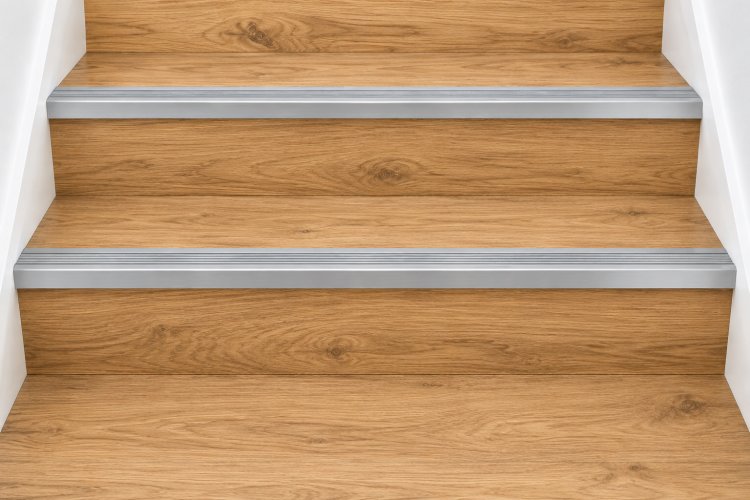
Aluminium stair nosing is one of those finishing details that quietly carries a lot of responsibility. It protects stair edges, improves safety underfoot, and helps create a clean, professional finish across a wide range of flooring types.
At Brass Tacks, our aluminium stair nosing is designed to perform consistently in demanding environments while still offering a neat, considered appearance.
It’s a straightforward solution, but an important one, especially where durability, safety and presentation all need to work together.
What Aluminium Stair Nosing Is Designed For
Aluminium stair nosing is installed on the leading edge of each step, which is the most exposed and heavily used part of a staircase. Without protection, this edge is often the first area to show wear, chip or break down.
Our profiles are designed to work with a wide range of flooring types, including:
- Stone and natural materials: These surfaces can be prone to chipping on exposed edges, so aluminium nosing helps reinforce and protect the most vulnerable point of the step.
- Timber and engineered wood: Wooden stairs naturally wear down over time in high-use areas, and nosing helps preserve the structure and appearance of the tread.
- Ceramic and porcelain tiles: These hard finishes can crack or fracture at the edges under impact, so stair nosing provides essential reinforcement and a clean transition.
- Laminates and other hard flooring systems: These materials benefit from a defined flooring edge detail that protects against lifting, wear and long-term surface damage.
In all cases, aluminium stair nosing helps extend the life of the flooring while maintaining a neat, consistent finish.
Built for High Footfall Areas
In busy environments, staircases are under constant pressure. Aluminium floor edging is widely used because it strengthens the step edge and helps maintain appearance and safety over time.
It is commonly specified for:
- Retail stores and shopping environments: These areas experience continuous customer traffic throughout the day, meaning stair edges must remain durable, safe and visually presentable despite constant use.
- Offices and commercial buildings: Workplace stairs are used daily by employees and visitors, so the finish needs to stay professional and intact even under regular foot traffic.
- Schools, hospitals and public buildings: These environments require robust, low-maintenance solutions that can withstand heavy and repeated use while supporting clear step definition for safety.
- Transport hubs and busy shared spaces: With large numbers of people moving quickly through these spaces, stair edges are exposed to constant impact, making reinforcement essential for longevity and safety.
Across all of these settings, aluminium stair nosing provides a practical way to manage wear while keeping stairs safe and functional.
Suitable for Internal and External Use
Aluminium is a strong and corrosion-resistant material, which makes it suitable for both internal and external applications. This versatility is one of the reasons it is so widely specified.
- Internal staircases benefit from a clean, durable edge that holds up well under everyday use in residential, commercial and public environments.
- External staircases benefit from aluminium’s resistance to weathering, ensuring the profile maintains its strength and appearance even when exposed to rain, temperature changes and general outdoor conditions.
This makes aluminium stair nosing ideal for projects where consistency between indoor and outdoor areas is important.
A Clean Finish for Multiple Sectors
Aluminium stair nosing is used across a wide range of industries because it provides a reliable solution that works in both functional and design-led environments.
It is commonly used by:
- Retail fit-out teams: These teams rely on durable and visually consistent finishes that can cope with heavy customer use while maintaining a professional appearance.
- Commercial developers: In commercial builds, long-term performance and low maintenance are key priorities, making aluminium stair nosing a dependable specification choice.
- Public sector projects: Schools, hospitals and local authority buildings require safe, durable solutions that meet strict usage and compliance demands.
- Interior designers and architects: Design professionals use aluminium nosing to achieve clean detailing that works across different materials without compromising the overall aesthetic.
- Yacht and ship builders: Marine environments require bespoke, corrosion-resistant components that perform well in compact, high-use and often challenging conditions.
In each case, the focus is on reliability, durability and a consistent finish.
Floor Edging That Improves Safety and Longevity
Aluminium stair nosing is not just about appearance, it plays an important role in everyday safety and long-term maintenance.
It helps to:
- Reduce wear on stair edges: By reinforcing the most exposed part of the step, it significantly slows down surface deterioration over time.
- Improve step visibility: A defined edge makes stairs easier to identify, which is especially important in busy or low-light environments.
- Enhance underfoot safety: Many profiles provide additional grip, helping to reduce the risk of slips and trips.
- Protect flooring materials: By absorbing impact at the edge, it prevents chipping, cracking and general structural damage to the floor finish.
This combination of safety and durability makes it a practical, long-term solution for almost any staircase.
Finishes and Visual Options
While performance is essential, aluminium stair nosing also needs to work visually within a space.
Different finishes are available to suit a range of design requirements, allowing the profile to either blend in or stand out depending on the desired effect.
- In modern commercial interiors, it can be used to create a clean, subtle edge that integrates seamlessly with surrounding materials.
- In more functional environments, a contrasting finish can be used to improve step definition and visibility.
- In traditional or natural schemes, finishes can be selected to complement wood, stone or tile surfaces for a more cohesive look.
- In larger developments, consistent finishes help maintain a unified appearance across multiple staircases and areas.
This flexibility ensures aluminium floor edging can adapt to both design-led and practical specifications.
Tailored Sizing for Project Requirements
No two staircases are exactly the same, which is why tailored sizing can be seen as an important part of the offering at Brass Tacks.
Custom sizing allows aluminium stair nosing to be accurately produced for a wide range of applications, including:
- New build developments: Where precise specification ensures a consistent finish across multiple staircases and floors.
- Refurbishment projects: Where existing structures often require non-standard sizing to achieve a proper fit and finish.
- Bespoke architectural designs: Where detailing must align with specific design intent and material choices.
- Marine and yacht interiors: Where space constraints and bespoke layouts require precision-made components.
- Irregular or complex stair layouts: Where standard off-the-shelf profiles are not suitable for accurate installation.
This level of flexibility ensures the final result is both functional and visually precise.
A Reliable Specification for Architects and Contractors
Aluminium stair nosing remains a trusted choice across the construction and design industries because it offers a simple, proven solution to a common problem.
It helps professionals achieve:
- Consistent detailing across different materials and finishes
- Long-lasting protection in high-use environments
- Improved safety compliance on staircases
- A clean, professional finish that is easy to specify and install
It is a practical product that integrates easily into a wide variety of projects without adding unnecessary complexity.
A Simple Detail That Makes a Lasting Difference
Aluminium stair nosing may be a small part of a larger build, but it has a significant impact on how a staircase performs over time.
It protects vulnerable edges, improves safety, and helps maintain a clean, consistent finish across busy environments. Whether used in retail, commercial, public sector or specialist marine projects, it remains a dependable and widely used solution.
Ultimately, it’s one of those details that quietly does its job every day, keeping spaces safer, stronger with a better finished for longer.